
From Waste to Worth: Why the Future of Fashion Is Being Built in the Margins
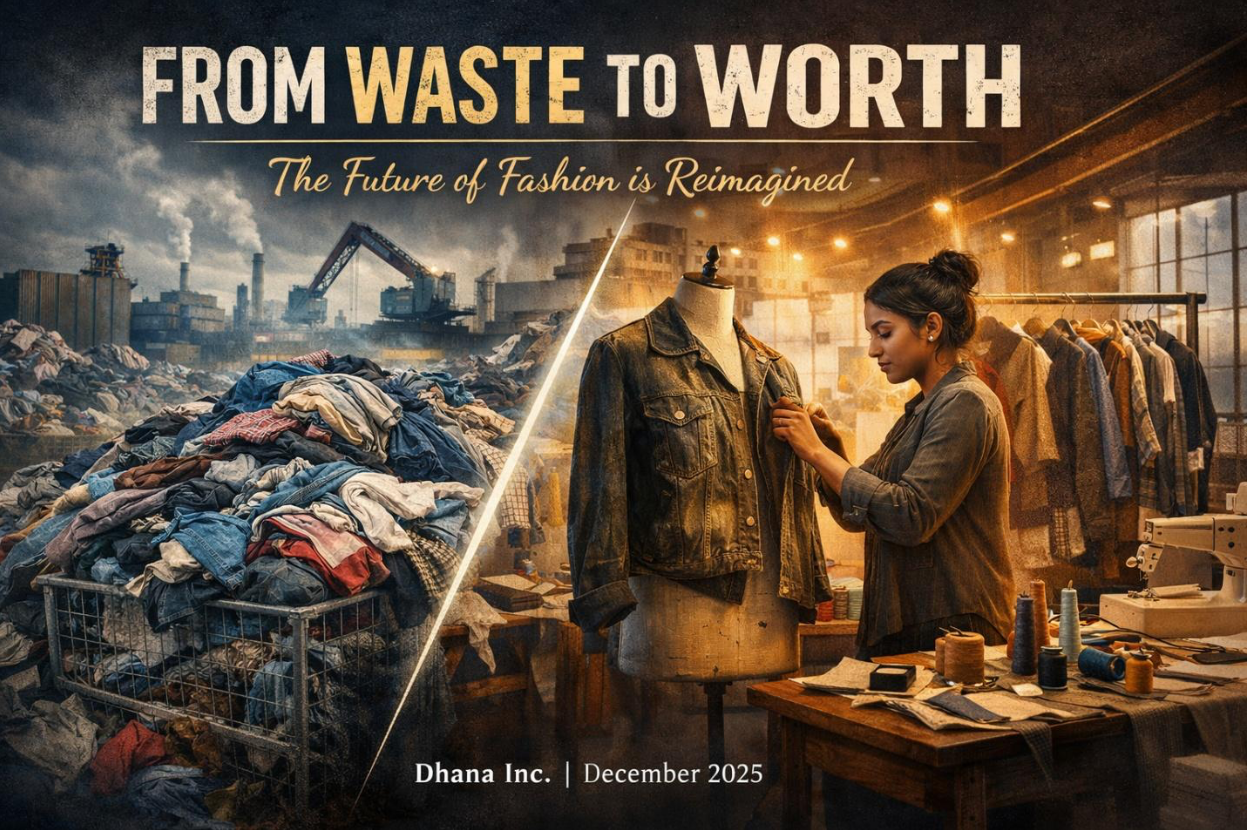
“Creativity begins where systems fail. When the old rules no longer work, imagination becomes not optional—but necessary.”
For decades, the fashion industry has treated waste as an unfortunate byproduct—something to be minimized, hidden, exported, or buried. Meanwhile, the waste industry has treated textiles as a logistical problem: heavy, complex, low-value, and expensive to process. Each side optimized its own system, rarely speaking the same language.
That era is ending.
A new generation of consumers—particularly Gen Z—is not asking for cheaper clothes. They are asking better questions: Where did this come from? Who touched it before me? Why does it exist at all? Words like pre-loved, reworked, and vintage are not trends; they are signals. They reveal a fundamental shift in how value is perceived, created, and communicated.
Recent commentary in the waste sector has begun to recognize this shift. Articles pointing out that materials once destined for disposal fees can now become revenue streams are not wrong. But they are incomplete.
Because the real opportunity is not simply to sell waste differently. The opportunity is to redesign the system that decides what waste is in the first place.
“Waste is not a material problem—it is a design failure. And design failures can be redesigned.”
At Dhana Inc., we believe we are standing at the threshold of a new industrial logic—one where textiles are no longer defined by their end of life, but by their capacity for transformation. This is not a story about recycling. It is a story about design infrastructure, creative supply chains, and the re-humanization of value.
Waste Is Not the Product. Context Is.
The fashion industry produces over 100 billion garments annually. Most are designed for speed, not longevity. When these garments enter the waste stream, they lose their context. They become anonymous—sorted by fiber content, weight, or resale grade, stripped of story, origin, and potential.
Yet paradoxically, the same garment, when reintroduced through the right channel, can command exponential value. A pair of vintage jeans sourced from a resale platform may sell for hundreds of dollars, while an identical pair compressed into a bale is priced by the pound.
What changed?
Not the garment.
The context.
“Value is created when we remember what a garment has lived through—not when we erase its past.”
This is the fundamental misunderstanding at the heart of the waste-to-fashion conversation. Value is not inherent in the object; it is produced through framing, access, and intention. Designers, resellers, and upcycling brands are not buying waste—they are buying possibility. They are buying raw material that has not yet been stripped of meaning.
The reason waste companies struggle to capture this value is not a lack of material. It is a lack of interface.
The Missing Middle: Where Systems Break Down
Between textile recovery and fashion creation lies a vast, underdeveloped middle ground. This is where garments are assessed not just for resale or recycling, but for design potential. It is where questions like these should be asked:
Can this garment be deconstructed?
Can it be re-patterned?
Does its wear tell a story worth preserving?
Can its material integrity support transformation?
Can its origin be traced and communicated?
Today, these questions are answered informally—by individual designers rifling through racks, by resellers with trained eyes, by small brands operating at human scale. This is why the premium vintage and upcycling market feels artisanal and scarce. It relies on intuition, labor, and luck.
“Intuition is powerful—but without systems, it cannot scale, protect workers, or sustain creativity.”
If circular fashion is to move beyond niche appeal, we must build systems that translate waste streams into design intelligence.
The Premium Niche Is Not a Niche. It Is a Prototype.
Luxury vintage and upcycled fashion are often framed as passion projects—small designers, boutique labels, limited runs. But this framing misses the point. These markets are not marginal; they are experimental labs demonstrating what happens when garments are treated as cultural artifacts rather than disposable units.
Luxury has always been about storytelling. What is new is who gets to tell the story.
Historically, fashion narratives were controlled by brands. Today, narratives are co-created by wearers, makers, and communities. The provenance of a garment—its past lives, its transformations, its journey—has become part of its value.
“The future of luxury is not perfection. It is participation.”
This is why phrases like “Recovered, sorted, and saved by [Your Company Name]” resonate. They acknowledge that value creation is collective. They elevate upstream actors from invisible suppliers to named contributors.
From Volume to Value: A New Role for Waste Operators
Waste operators are experts in logistics, compliance, and scale. They move enormous volumes efficiently. But volume thinking is fundamentally misaligned with premium reuse markets, which prioritize selection, quality, and narrative continuity.
This does not mean waste operators must become fashion brands. It means they must be invited into a different value equation.
“Circularity only works when every participant is visible—and valued.”
Dhana Inc.: Designing the Systems Between Industries
Dhana Inc. exists to build what the industry has been missing: the connective tissue between waste, design, and culture.
We do not believe circularity will be achieved through better messaging or marginal efficiency gains. We believe it will be achieved through new operating systems—tools that allow diverse stakeholders to collaborate without losing their identities or incentives.
“Collaboration is not consensus. It is the courage to build together without
erasing difference.”
Our work focuses on three principles:
Design Begins Before Creation
Digital Comes Before Physical
Value Is Co-Created
D/Sphere: From Textile Waste to Design-Ready Assets
The D/Sphere platform transforms physical garments into design-ready digital assets, enabling collaboration before physical intervention occurs.
“Digital tools should not replace the hand—they should protect it.”
This approach allows designers, waste operators, and brands to collaborate intentionally, reducing waste while increasing creative agency.
Storytelling as a Shared, Verifiable Asset
One of the most powerful insights emerging from Gen Z consumption patterns is that storytelling is no longer decorative—it is functional.
“Story is not marketing. Story is accountability.”
D/Sphere embeds storytelling into the production process itself, enabling verified provenance and shared authorship.
Why This Matters Now
We are at an inflection point.
“Conscious living is not about consuming less—it is about consuming with awareness, responsibility, and care.”
The question is no longer whether waste can become value. The question is who will build the systems that allow it to happen responsibly, at scale, and with integrity.
A Call to Collaborate
The future of fashion will not be built by a single sector. It will be co-created.
“The garments we discard today are unfinished conversations. Our responsibility is to listen before we design.”
At Dhana Inc., we invite partners across the value chain to help shape this future—not as a marketing exercise, but as a systems challenge worth solving.
Because the garments we discard today are not trash.
They are unfinished stories.
And the systems we build now will determine whether those stories are lost—or transformed into something worth wearing forward.